
The euphemistic term "emergence" is often used in medicine to describe the evolutionary processes by which living systems acquire resistance to chemotherapy. The purpose of this meeting is to understand clinical resistance from the perspective that it is best understood, and therefore controlled, if we adopt an evolutionary perspective from the start.
Reflecting the importance of the different disciplines needed to tackle the problem of drug resistance, our invited speakers represent a wide range of methodological approaches.
With an emphasis on the relevance to past but also potential future clinical studies, speakers will address different aspects of the resistance problem. Topics for discussion include antibiotic discovery, antibiotic stewardship in the clinic, rapid pathogen diagnosis, bioinformatics approaches to clinical resistance adaptation, reduced-dose trials using malaria in vivo models, in vitro models of resistance adaptation studied using ideas from systems biology, in addition to theoretical, epidemiological modelling.
The aim of this network is to bring together mathematicians and life scientists to explore the challenges and generate solutions to some of the major problems facing evolutionary ecology.
The network was inspired by two fundamental questions What
determines species diversity? and How did cooperative
behaviour evolve?
Understanding the ecological and evolutionary mechanism involved in creation and maintenance of both microbial diversity and cooperative behaviour is a complex task. It can be studied at many levels from multi-trophic, through to population and down to cellular and molecular. This clearly requires input from a range of scientists, from mathematicians, theoretical modelers, experimental microbial ecologists, microbiologists to biochemists which is reflected in the core membership.
 Microbial Communities: From the Lab to Natural Environments
The aim of this workshop is to bridge the gap between mathematical models, laboratory models and natural ecosystems. Speakers talked about plant and human pathogens, natural fungal ecosystems, consortia of symbionts, their responses to antibiotics and viruses and single-cell observations of bacteria in microfluidic devices.
 Mathematics of
Microbes: Biological Details of the Evolving Cell
Mathematics of
Microbes: Biological Details of the Evolving CellAn international conference assembling a cross-disciplinary panel of internationally leading speakers presenting current research relating to microbes and antimicrobials, including the action of, and evolution of resistance to antibiotics, phage and peptides. A central theme is 'detail and ecology': how far inside the cell must we look to understand what is happening outside?
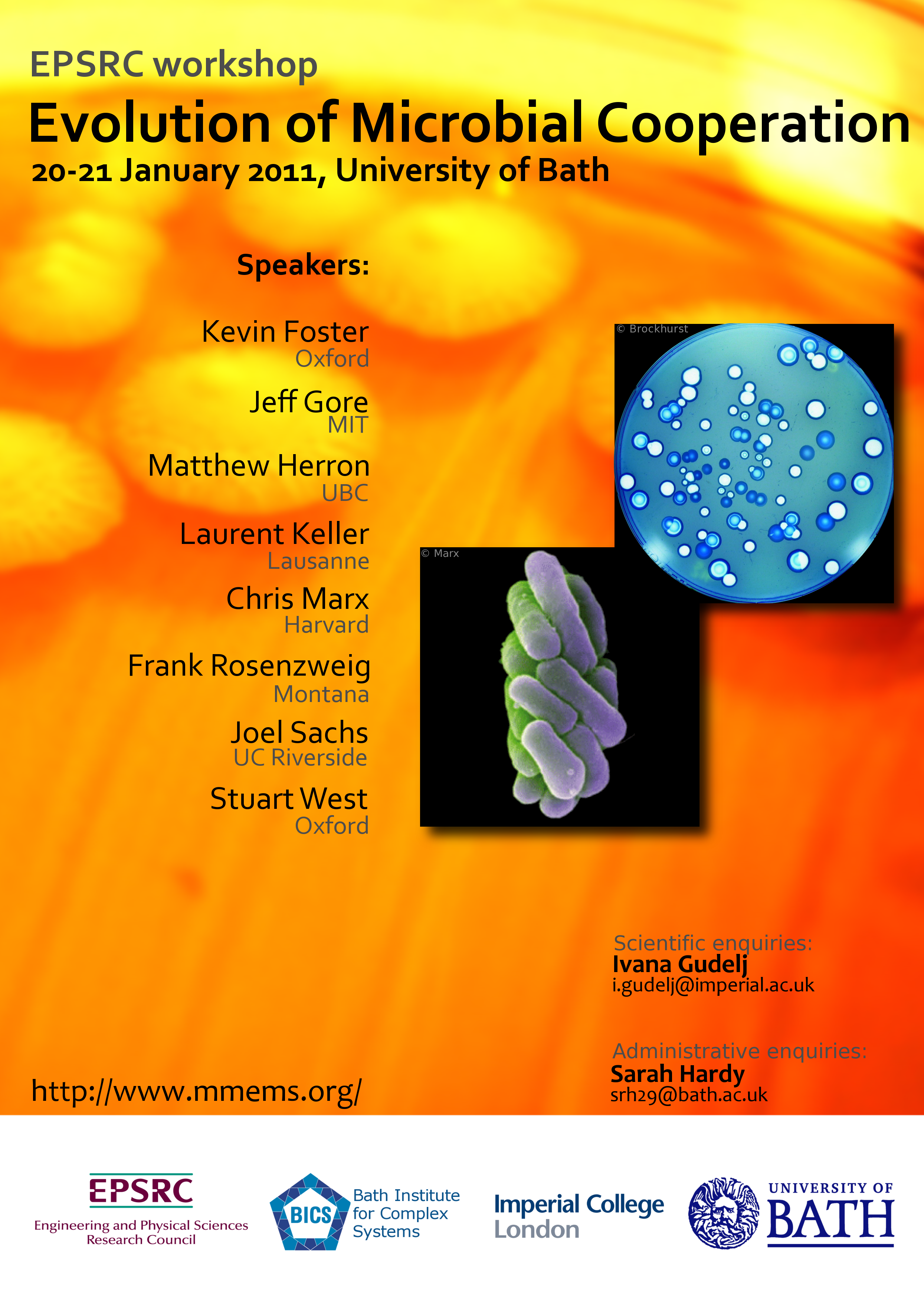 Evolution of
Microbial Cooperation
Evolution of
Microbial CooperationThe workshop will bring together experimentalists and modelers interested in microbial cooperation from molecular and genetic detail thought to population level interactions.
 Coevolution:
Models and microbial model systems
Coevolution:
Models and microbial model systemsCoevolution is a fundamental process in evolution. The aim of this workshop is to bring together empiricists using experimental evolution to study coevolution with theoreticians to develop new modelling approaches and to highlight exciting new developments of coevolutionary theory requiring experimental tests.
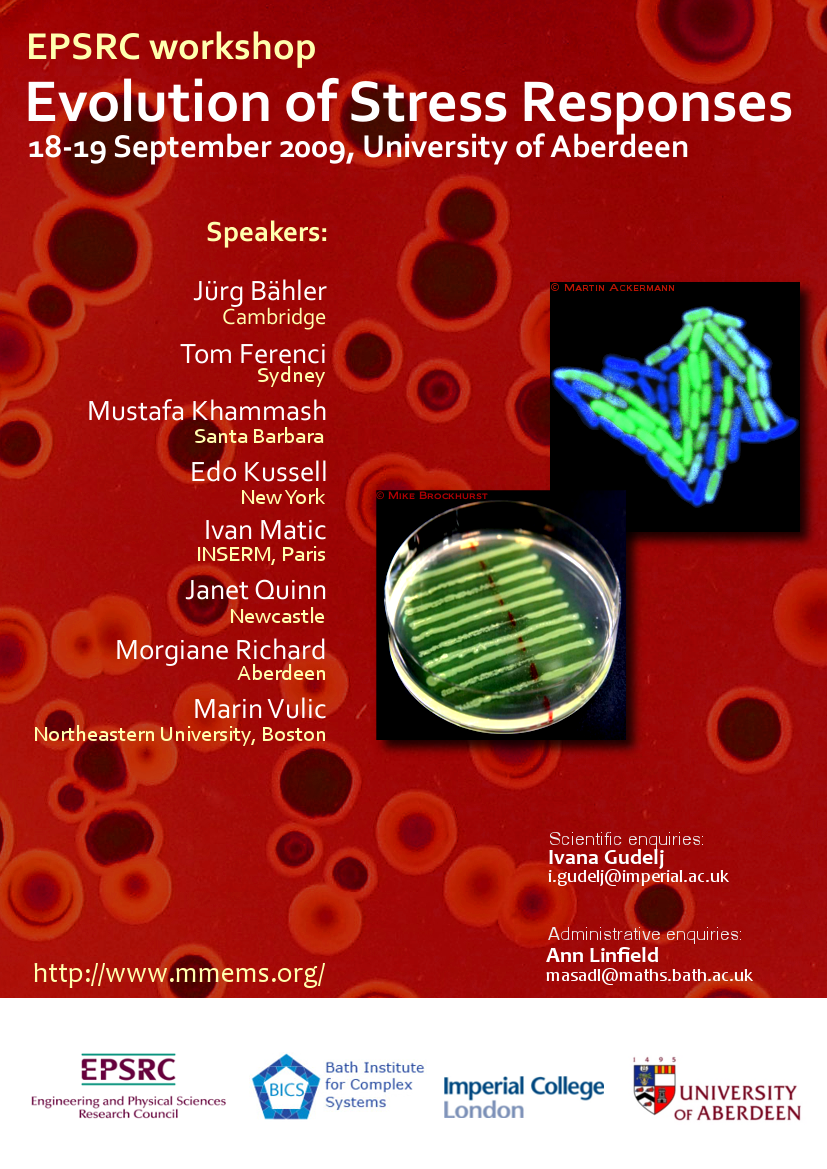 Evolution of Stress Responses
The workshop broadly covered eukaryotic and prokaryotic stress responses at both cell and population levels.
 Evolution of
Antibiotic Resistance
Evolution of
Antibiotic ResistanceThe aim of the workshop is to bring together the following three groups of scientists: experts in genotyping, experimental evolution and mathematical modeling.
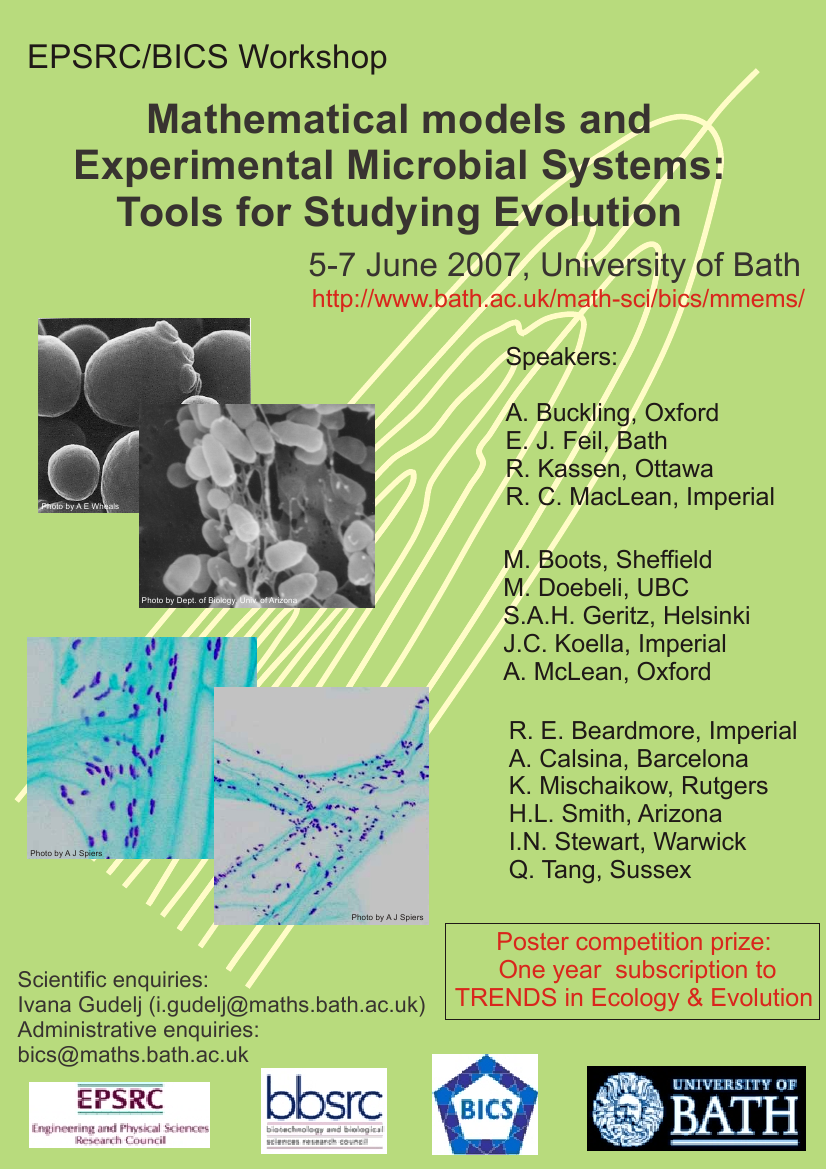 Mathematical Models and Experimental Microbial
Systems: Tools for Studying Evolution
Mathematical Models and Experimental Microbial
Systems: Tools for Studying EvolutionThis workshop is intended to provide an arena for much-needed interaction between microbial experimentalists and mathematicians focused around the following evolutionary questions: What determines species diversity? and How did cooperative behaviour evolve?


registration »